
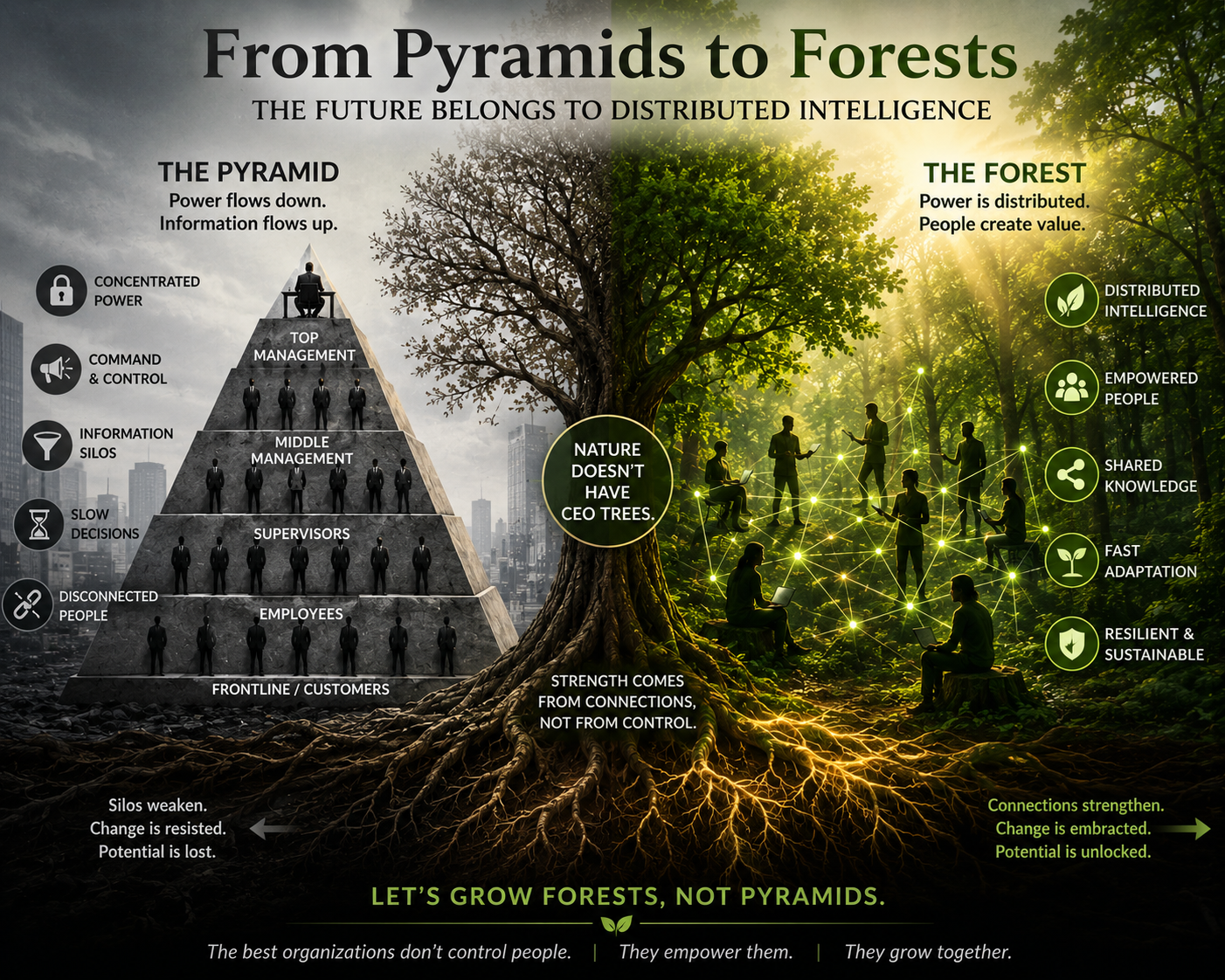
For most of my professional life, I worked within traditional organizational structures.
Like most organizations, they were designed as pyramids.
Authority at the top.
Instructions flowing downward.
Information flowing upward.
For a long time, this seemed natural.
Then I began asking a simple question:
If nature has spent millions of years perfecting systems that survive and adapt, why do we rarely learn from them when designing organizations?
Consider a forest.
There is no CEO tree.
No board of directors tree.
No central command centre.
Yet forests thrive.
They survive storms, droughts, disease, and changing environments.
They continuously adapt.
They regenerate.
They share resources.
They support new growth.
What fascinated me was that intelligence in a forest appears to be distributed rather than concentrated.
The health of the system depends not on one dominant tree, but on countless interactions throughout the ecosystem.
Years after forming these thoughts, I watched a BBC HARDtalk interview where the concept of a "bottom-up" organization was being discussed.
It struck a chord.
Perhaps the strongest organizations are not those where all decisions originate at the top.
Perhaps they are those where leadership creates the conditions for knowledge, initiative, and innovation to emerge throughout the system.
Today, Artificial Intelligence is accelerating this shift.
Knowledge is no longer confined to a few people at the top.
Information is becoming accessible to everyone.
The organizations that thrive may be those that learn to harness collective intelligence rather than simply manage hierarchy.
Maybe the future belongs not to larger pyramids...
but to smarter forests.
What do you think?