
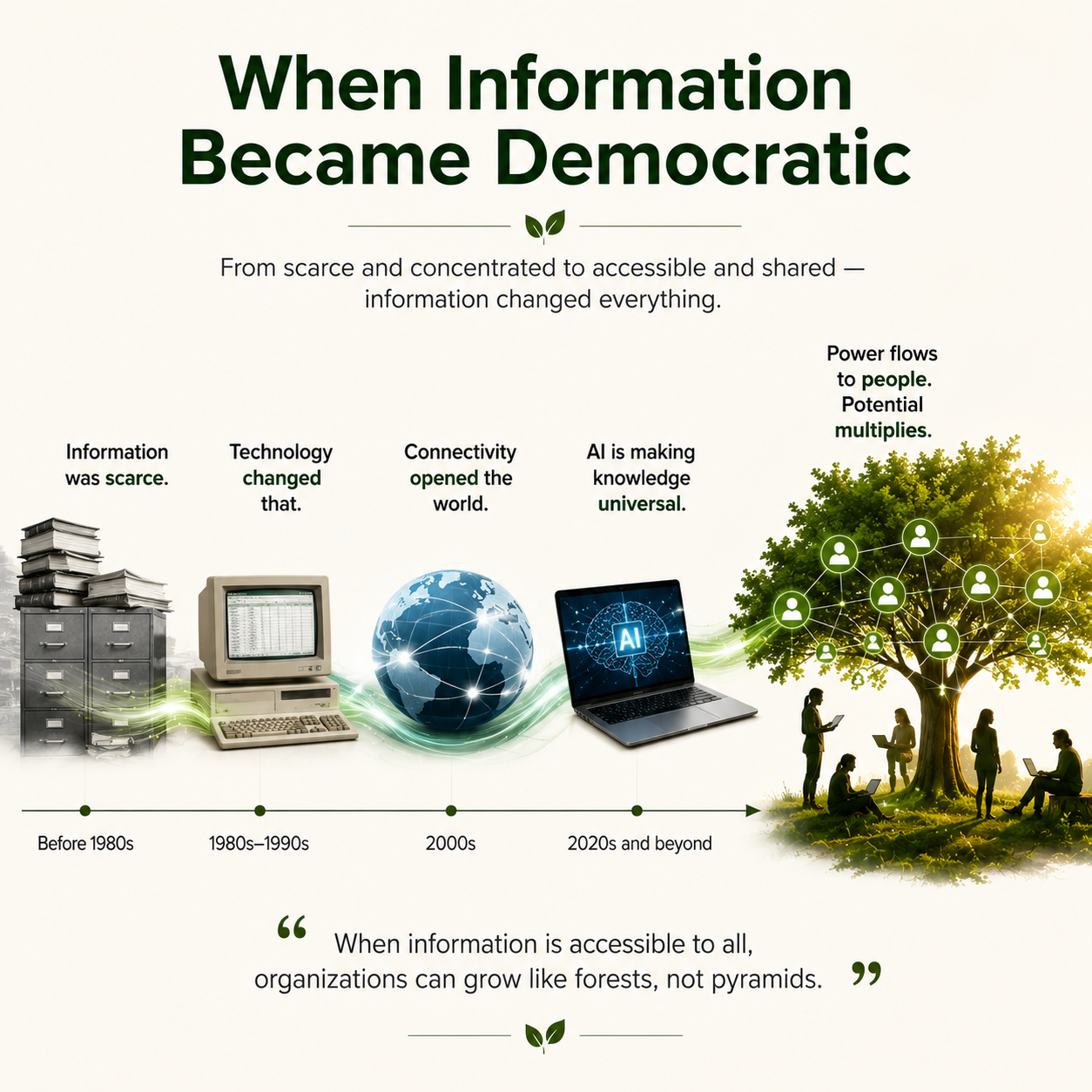
When I graduated from IIT Delhi in 1976, information was scarce.
If you wanted technical knowledge, you went to a library.
If you needed data, you searched through files.
If you wanted expert advice, you had to find the expert.
Knowledge was concentrated.
Access was limited.
And those who controlled information often controlled decisions.
Then something remarkable happened.
Personal computers arrived.
Spreadsheets arrived.
Databases arrived.
The Internet arrived.
Suddenly, information was no longer trapped inside filing cabinets, departments, or the minds of a few specialists.
Knowledge began moving closer to the people who actually needed it.
Engineers could analyze data themselves.
Managers could access information directly.
Employees could solve problems without waiting for instructions to travel down a hierarchy.
The flow of information started changing the flow of power.
Today, Artificial Intelligence is accelerating that transformation even further.
For the first time in history, a person sitting anywhere in the world can access knowledge, insights, and analytical capabilities that were once available only to large institutions.
This raises an important question.
If knowledge is becoming increasingly accessible to everyone, should organizations continue to be designed around information scarcity?
Or should they be redesigned around information abundance?
Perhaps the future belongs to organizations that trust people with information rather than control them through it.
Perhaps leadership in the AI era will be less about having all the answers...
and more about helping others ask better questions.
What do you think?