
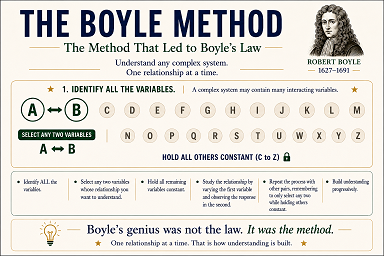
Most of us studied Boyle's Law in school.
Some may still remember the equation.
Many may remember that pressure is inversely proportional to volume.
A few may even remember the condition:
Provided the temperature is held constant.
What fascinated me much later in life was not the law itself.
It was the method that led to the law.
Before Boyle, scientists were observing pressure, volume, and temperature.
All three were changing simultaneously.
Relationships were difficult to see.
Boyle's breakthrough was not merely discovering a law.
His breakthrough was recognizing that to understand the relationship between two variables, all the others must first be identified and then held constant.
That simple insight led me to a broader observation.
In science, organizations, families, partnerships, and even friendships, we often try to deal with everything at the same time.
One issue becomes five.
Five become ten.
The discussion moves from today's concern to yesterday's grievance and tomorrow's uncertainty.
Soon, nobody knows what is affecting what.
Perhaps a better approach is what I now call The Boyle Method:
- Identify ALL the variables.
- Select any two variables whose relationship you want to understand.
- Hold all remaining variables constant.
- Study the relationship between the chosen pair.
- Repeat the process with other pairs.
- Build understanding progressively.
The law that emerged from Boyle's work transformed science.
But perhaps the method that led to it can help us understand many things beyond science.
Boyle's genius was not the law.
It was the method.
What do you think?