
Many years ago, during a two-day workshop in Mumbai, we had an hour to spare after lunch before dispersing.
Someone suggested we use the time for an informal discussion.
I chose a simple topic:
"What's in a name?"
Most participants thought it would be a light filler session.
So did I.
What followed turned out to be one of the most insightful discussions of the workshop.
I asked a simple question:
"How would you name the front left door of a car?"
The room was full of experienced professionals.
Everyone had been writing assessment reports for years.
Yet when we compared notes, we discovered that almost everyone used a different naming style.
Some wrote:
- Front Left Door
- Left Front Door
- Front Door Left
- Door Front Left
All of them seemed correct.
After all, we are talking about the same part.
But are they equally useful?
Let us examine it.
To identify any door, we only need three words:
- Door
- Front or Rear
- Left or Right
Nothing more.
Nothing less.
The interesting question is not whether the name is correct.
The interesting question is whether the name helps us find the information later.
In the paper world, almost any naming style works.
In the digital world, naming becomes critical.
If a database contains millions of records, where should the search begin?
With "Left"?
That could refer to hundreds of parts.
With "Front"?
That could refer to dozens more.
But if the subject is a door, why not begin with the word Door?
The moment we start with the subject, the search narrows immediately.
The remaining words simply qualify it.
That was the moment the discussion changed.
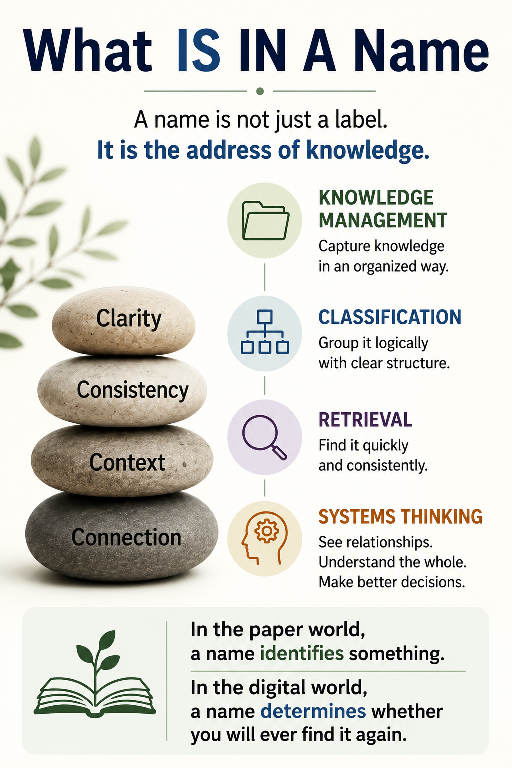
We realized that a name is not merely an identifier.
A name is a retrieval mechanism.
And that is how conventions are born.
Not because somebody imposes them.
But because people collectively recognize that one approach reduces confusion and improves understanding.
The lesson stayed with me long after the workshop ended.
In the paper world, a name identifies something.
In the digital world, a name determines whether you will ever find it again.
A name is not just a label.
It is the address of knowledge.